What is the 'Left'?
Part 2 of 'The Place of the Left in the Struggle to End Imperialism'

This is part two of three posts that make up a talk on ‘The Place of the Left in the Struggle to End Imperialism’, given on 10th July 2026 at an international summer school organised by Fudan University in Shanghai
Part 1 is called ‘Can the workers of the world Unite?’
Part 3 is called ‘What is Imperialism?’
What are the grounds for the conclusions of part 1? They arise from, firstly, understanding what the Left really is in politics, and second, understanding what Imperialism is.
The dominant but wrong idea of a ‘left’ organisation is that it is any organisation which professes to make concessions to the workers. In consequence it is applied to organisations such as the US Democrats or the UK Labour Party, which spend 98 percent of their time attacking the workers of their nations, and 2 percent granting them a few crumbs from a cake that they have already given to the capitalists. This is contrasted with ‘right’ organisations who give the whole cake to the capitalists and tell the workers they are sitting at the table.
Actually, this notion of ‘left’ is a liberal idea, and it is the source of the utmost confusion. It is one of the reasons that so many workers in the USA and much of Europe are attracted to the far right which they see as fighting impositions, such as austerity, imposed by what they perceive as ‘left’ organisations. This is very convenient for the puppetmasters whose aim is austerity, regardless of who does it.
However, these parties have no connection with the left. The very idea that they constitute even remotely left organisations is a sick joke. When a ‘left’ appears inside them, it is either a fake leftist such as Andy Burnham or AOC, who differ from the leadership only as a means of getting into it, or becomes a quite distinct force, such as that which is forming around Mamdani, or which in the past formed around Tony Benn and Ken Livingstone and recently around Jeremy Corbyn, which is actually in direct conflict with the party, which is why they are witch-hunted and if possible, expelled.
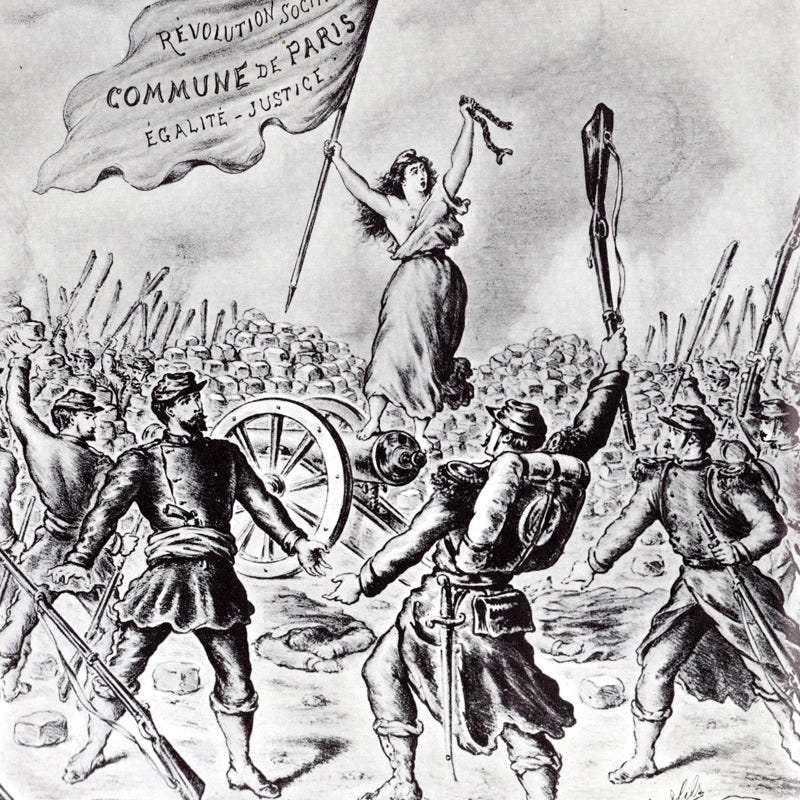
So what, actually, is the Left? Historically, the idea emerged from the French Revolution, when the most extreme parties of the revolution such as the Jacobins, sat on the benches on the left of the Assembly. Actually, these were the parties associated with political radicalism; this had two aspects. On the one hand they stood for the most radical democracy, leading a century later to the direct democracy of the Paris Commune, of which Marx and Engels wrote “This is the Dictatorship of the Proletariat”. On the other they stood for the most resolute action in implementing the demands of the revolution, and in particular, the most resolute action against its enemies.
This led, both in France and in revolutionary Russia, to a contradictory phenomenon which has preoccupied liberalism from then on; in order to secure the conditions for radical democracy, a precondition is the most radical action against its enemies. In France this led to the ‘terror’ and in Soviet Russia to the Civil War and the ruthless suppression of the capitalists. As a result, the Left earned itself the brand – invented of course by the liberals - of ‘authoritarianism’.
Yet this inverts the reality of the situation; the severity of the revolutionary measures undertaken by the Jacobins and the Bolsheviks alike was a consequence of the terrorist, dictatorial, and barbaric practices of the enemies of the people who went before them and fought to overthrow them. Against those enemies who exercised no restraint in the use of violence against the people, the only possible recourse of the revolutionaries was to end the existence of these enemies. In point of fact, the force they used to do so was, generally, the least necessary to achieve this purpose.
The apparent contradiction between radical democracy and the exercise of power therefore disguised the most fundamental feature that defined the left, namely, it was that section of the people which refused to compromise in defending the needs of the people, and it is this which I will take as my definition. The relevance of this definition to the current stage of the anti-imperialist struggles of the world will not, I hope be lost; what is required is the unity of those who will not give in to the imperialists, and this is the alliance that is being forged in West Asia, in the former Soviet Union, in Latin America and in so-called ‘French’ West Africa, to which the Left in the rest of the world should rally and unite with.
However, in Marx’s day there was a further, critical aspect of this division, which can be put quite simply; the working classes of revolutionary France, even in the broadest sense, were simply too small in number to constitute a majority. They therefore faced the dreadful choice of either compromising with the reaction, or ruling as a minority.
Marx’s analysis of the Europe of 1848, the next great revolutionary moment in European history, was therefore a fundamental step forward which was to redefine the left for the next hundred years. Marx’s analysis of capitalism convinced him that capitalism was bringing into being a majority class of people without property, and was preparing them, by the very fact of putting them to work its factories, buildings and mines, to exercise power as a majority. The basis therefore existed to eliminate the contradiction between democracy and resolution.
Achieving it, therefore, required that the working class organised to prepare itself for power, as the Manifesto puts it to ‘win the battle for democracy’ and ‘rise to the status of ruling class’.
This was, reduced to essentials, the platform of the Communists.
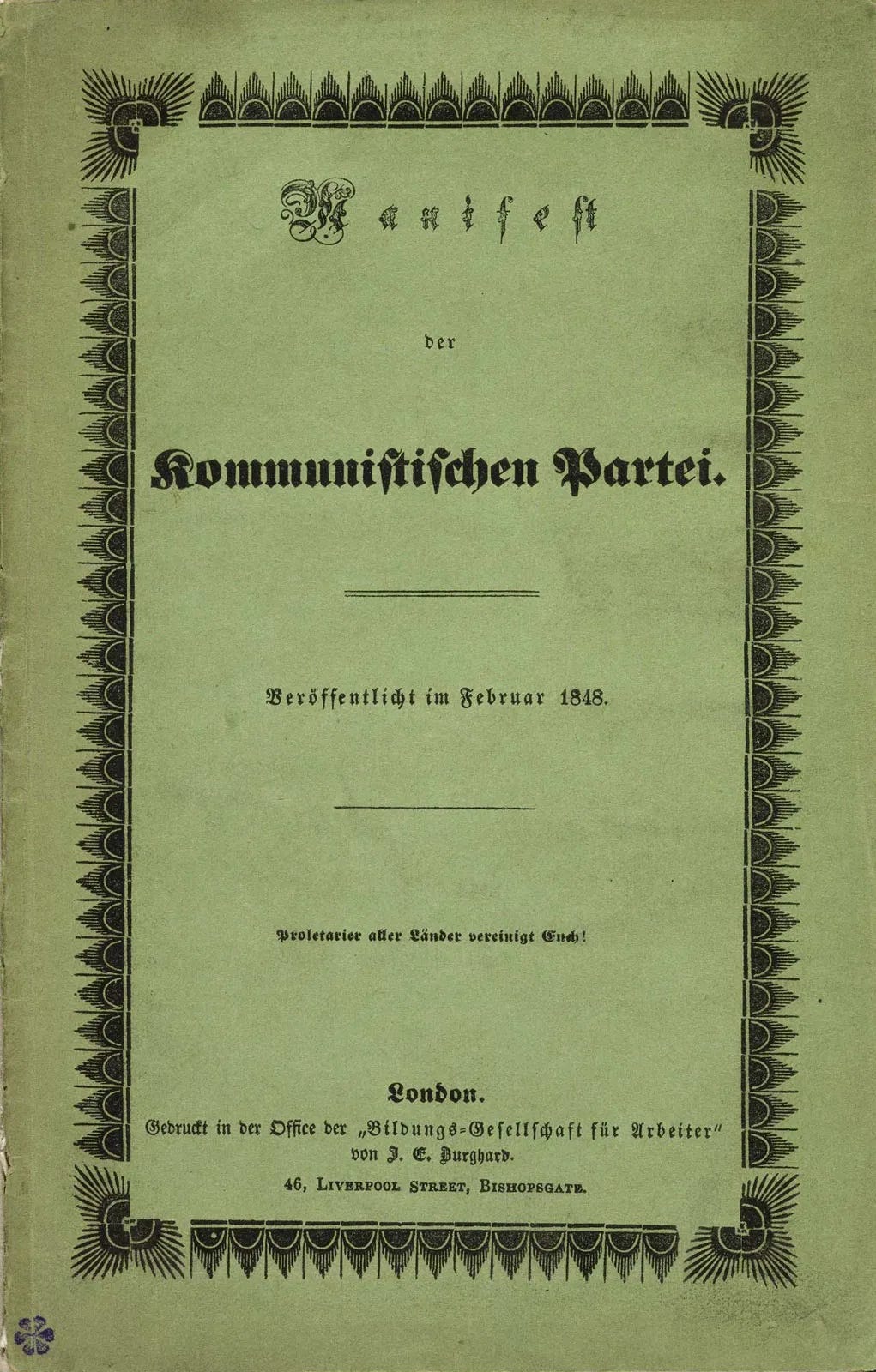
It is critical to note that the Manifesto’s Communism did not signify extreme economic radicalism. Marx and Engels did not seek to introduce a socialist utopia immediately, and the Manifesto’s economic programme is quite limited - almost Keynesian - in character. Its defining feature was its approach to power:
The first step in the revolution by the working class is to raise the proletariat to the position of ruling class to win the battle of democracy... The proletariat will use its political supremacy to wrest, by degree, all capital from the bourgeoisie, to centralise all instruments of production in the hands of the State, i.e., of the proletariat organised as the ruling class; and to increase the total productive forces as rapidly as possible
I have emphasised the most important words, namely ‘first step’ and ‘by degree’.
By the time the Second International was formed, a gap appeared between this political definition of the left and the emerging, Social Democratic idea that the most important battle was that for the economic demands of the workers. This is not of course to say that the Communists had no economic demands; the point is that it conceived of these demands as being implemented by an entirely new type of state.
It might be though that these amounted to the same thing – but they did not. Within the Social Democracy, the idea took shape that the economic demands of the workers could be obtained by compromising with the capitalist state. This by degrees led to the enticing, but illusory idea that sustainable economic and social advance could be secured, country by country, if the workers of each country actively supported their capitalist state.
Initially this idea was known as ‘reformism’ but the term disguises a much more sinister consequence; it mutated into support for imperialism. This was because the states of the European powers had, by 1900, become instruments dedicated to the imperialist enslavement of the people of the world. In reality, what took shape in the European social democracy was not just a reformist wing: it was a pro-imperialist wing of the workers’ movement.
The German Social Democracy was the first to fall. This took place under the influence of its popular but bombastic leader Ferdinand Lasalle even in Marx’s day. The essence of Lassalle’s policies was on the one hand, economic maximalism and on the other, political compromise.
Thus he promoted the ‘iron law of wages’ according to which it was pointless for workers to go on strike because the capitalist would simply claw back anything gained, by raising prices. But on the other hand, he secretly conspired with Bismarck to offer him the support of the Socialists for Germany’s war aims against Denmark in Schleswig-Holstein.
In contrast, the Left was that wing of the democratic movement which agreed with the Manifesto that:
the bourgeoisie is unfit any longer to be the ruling class in society, and to impose its conditions of existence upon society as an over-riding law.
Key to this analysis is therefore the dual opposite of Marx’s conclusion that the working class would become fit to rule – namely, the capitalists were unfit to rule. To take power was, therefore, not just a need of the working class but a duty to humanity, a necessity.
Consequently the defining feature of the Left, as the Communists saw it, is that above all, it was that part of the general working class movement which refused to compromise with the existing state.
It is noteworthy that this idea is shared with all the anti-imperialist forces we have discussed. The Iranians and the Venezuelans have, fundamentally, initiated a revolutionary process because they either, like the Iranians, dispensed with their state altogether or, like the Venezuelans, so transformed the character of their state in a series of defeats inflicted against attempted by the counterrevolution through mass popular mobilizations, that the result enshrined in both law and popular consciousness, an inviolable commitment to the rights of ordinary people.
What enrages capitalists worldwide is not the mere fact of favouring ordinary people, but the that those ordinary people should enjoy rights which override the rights of their exploiters.
This brings me to a critical point: what kind of state is required to resist imperialism? My argument is that it is the same kind of state as that required to resist capitalism. This is the objective basis for a world-historic alliance in which anti-imperialists and communists will work side by side.
The issues of Revolution and Communism come together as follows: it is not possible to override the rights of the capitalists without creating a new state, precisely because all capitalist states are build around the inviolability of capitalist property. This is why the Communist Manifesto calls for ‘despotic’ inroads into private property. It simply means that the workers, having won the battle for democracy, will treat private property as a conditional, not an inviolable, right. If the capitalists respect the rights of the nation, they may function on that basis. Once the rights of the nation conflict with the rights of the capitalists, they must give way and if they don’t, they will lose their property.
The Communists of the Manifesto, and of the Comintern, aimed to establish such a state, a state whose early form Weydemeyer (1852) famously described as the ‘dictatorship of the proletariat’. Contrary to Western propaganda, this signified not the abuse of power but its morally legitimate use to override misuses of property that conflicted with the rights of the people.
The Western ‘Left’ in contrast came to conceive of socialism as enacting reforms that preserved the rights of the owners of property intact. This is the origin of the misleading notion that socialism means redistributing wealth, rather than exercising power over it.
This is not all. The character of any state is determined by the source of income of its ruling classes - which in the West means Imperialist Capital. Its income derives from the labour not just of its own workers but that of the other four-fifths of the world. The Western ‘Left’ parties therefore entered a Faustian compact which lies at the heart of their militarism, their racism and their current hostility to Russia. They undertook to leave intact the right to exploit the entire world in return for a share of the spoils. To speak of such parties as ‘Left’ is an offence against language, reason, and morality.
Yet if they are not ‘Left’, what are they? They are best understood as parties of middle class liberalism, using the term ‘liberal’ correctly to mean the political project of the anti-aristocratic capitalist parties of the French and American Revolutions. As Losurdo (2011) explains in his magnificent counter-history of liberalism, ‘Liberty’ for these parties meant the unhindered freedom to own and use private property. The only issue that divides ‘Left’ liberalism from Right neoliberalism is how this fake freedom should be used. For the genuine Left, the property-owners should not be granted any unconditional freedoms at all.
When we speak of the ‘Left’, therefore, we refer to those parties and movements that seek, or claimed to represent the independent needs of the propertyless classes and which refuse to make any compromise in pressing their demands. This is not an antiquarian project. As the world enters a period of tumultuous change, the need for a mass world Left will, we believe, again come to the fore. This calls for a strategic debate on the kind of parties, and the relations between them, that are needed.
Part two.